
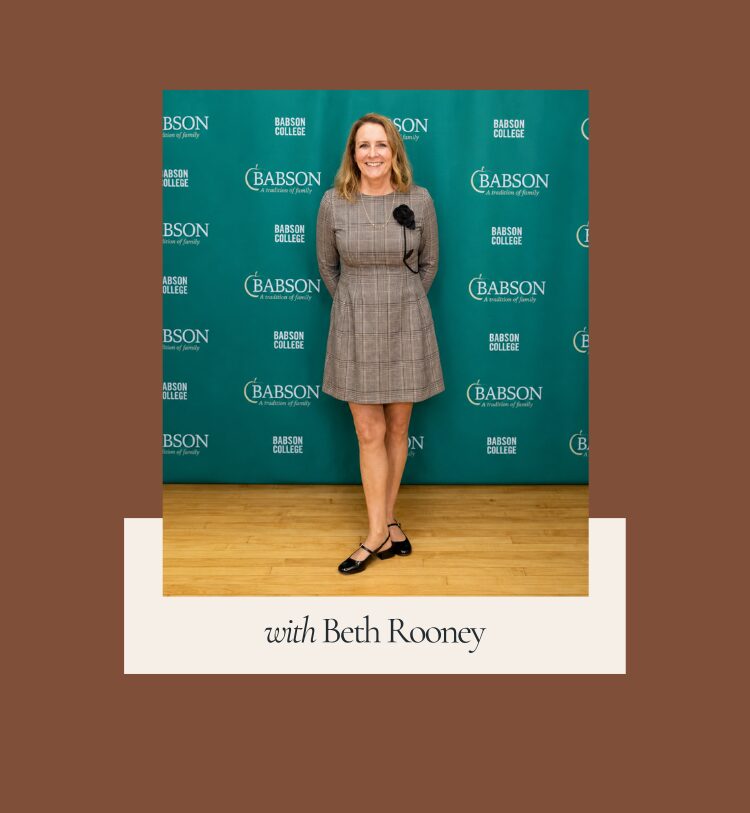


Beth Rooney spent 15 years telling agents to get on social media. She was the sales manager. Year after year at her sales meetings: put your face on camera, you can’t be a secret agent, do it, do it, do it. Hardly anybody did.
Then she got back into production herself, and she took her own advice. Last year Beth did $6 million. This year she’s on pace for $28 million. No team. No assistant. In this week’s episode of The Powerhouse Effect, we pull apart exactly how that happened, and the answer isn’t a lead source. It’s a sentence Beth said near the end that I haven’t stopped thinking about: the brokerage is not the brand. The agent is the brand. Let’s get into it.
Why is your personal brand worth more than your brokerage’s?
Because people want to do business with a human being, not a corporate logo.
Here’s how Beth put it: the big well-known brands want agents to believe they’re successful because of the brokerage brand. It’s really not the case. It’s the agent. And here’s the truth most agents never sit with: if every agent treated their business like they were the CEO of their own brand, they’d have the same success Beth is having.
That’s a big mindset shift, especially if you came up inside a traditional brokerage where the office was the identity. Beth lived both lives. She managed offices in what she calls the olden days, when clients called the office and walked into the office and the brand on the door mattered. Now she’s building in the digital era, where your face, your content, and your reputation ARE the storefront. eXp Realty happens to be a small brand in her greater Boston market. Her response? If it’s not number one in my community right now, that makes it easy for me to make it number one.
How do you get back into real estate after years in management?
Beth’s path back was not a straight line. Eleven years at Fidelity. Then real estate as a new mom of three boys, where she replaced her corporate income her first year but burned out on nights and weekends. Then 15 years as a sales manager, out of production entirely, because it fit her life while her kids were small. She had her fourth, a girl, and for a long stretch the trade worked. Until her kids grew up and it didn’t.
Getting out cost her something, too. Her old company had the kind of grueling non-compete that eXp doesn’t do, and she had to park her license an hour away on Cape Cod for a year while it ran out. She calls herself an eXp orphan: she found the model through her own research online, not through a recruiter. Then a friend connected her to Powerhouse, and she was in the room.
If you’re sitting in a version of Beth’s old seat, in management, on a team, or just years removed from your last closing, hear the timeline clearly: she went from “my sphere doesn’t even know I can sell” to a $28 million pace in about a year. Experience doesn’t expire. It compounds while you’re not looking.
How do you make neighborhood tour videos that win business?
Beth’s signature play right now is almost embarrassingly simple. She takes her dog for a walk through a neighborhood and talks about it on camera. What the average price point is. How many homes are in there. What makes it different from the neighborhood next door. If there’s an interesting house on the market, she times the video around it. Her daughter, home from college, or one of her sons films it.
She’s made five or six. The first one hit 11,000 views. The rest pull 3,000 to 4,000. And the offline effect is the part I need you to hear: she goes out to dinner and people who have never once liked or commented tell her they watch everything she posts. Her husband laughs about it because it happens every time they go out.
Beth wants to call the series low budget. I’d call it high investment. Count what one video actually does: it markets a neighborhood, it markets a listing, it markets Beth as THE local expert, her kids learn her business, and she gets an afternoon with them while they film. Five boxes, one dog walk.
If the thing stopping you is deciding what to post every week, that’s exactly what The Weekly Edit hands you: the week’s content, planned and written, so you can go walk the dog.
How does the Instagram algorithm actually work for real estate agents?
Most agents think Instagram’s job is to go find them strangers, so they obsess over follower counts. That’s backwards. The algorithm connects you with people you already know, and then with friends of those people.
Say your best friend Susan watches everything you post. Susan has a friend, Carrie, who lives 20 minutes away and behaves a lot like Susan online. Instagram notices Susan loving your content and quietly starts showing it to Carrie. That’s the trickle-down effect, and it’s why a local agent with 2,000 engaged followers can out-earn an influencer with 50,000 scattered ones. You don’t need a ton of followers. You need entertaining content, because entertainment is what earns the algorithm’s trust.
Notice that this is exactly why Beth’s dog-walk series works. Her audience is her town. The algorithm hands her content to her town’s friends. And the viewers who never like or comment, the silent watchers who stop her at dinner? They’re sellers.
How do you win listings from your sphere of influence?
Beth’s production isn’t coming from a portal or a funnel. When she traces it back, it’s coming from her sphere. The leap happened when the word finally got out that she’s here and available to help.
That phrase is doing a lot of work. Beth’s problem was never that people didn’t know her or trust her. It’s that for 15 years she couldn’t list or sell, so nobody thought of her that way. Social media’s real job in her business was re-introduction: telling a sphere that already loved her that she’s back in production.
My favorite example: she won a $2 million listing this year as the THIRD agent through the door. The sellers knew her because their daughter played soccer with hers. She wasn’t their first thought, because she hadn’t been listing and selling. But when she sat at their table, she already knew them, and she carried 15 years of being the person agents called when a deal went sideways. She’s seen everything. The deal side of this business is the easy part for her, the way your fourth baby is easier than your first. That combination, familiar face plus deep expertise, beat whoever walked in first.
How do you stand out in a listing presentation?
Here’s Beth’s pitch when she sits in front of a seller: in the first week, I’m going to put 12,000 eyeballs on your property, mostly in the greater Boston market. And yes, you’ll get the glossy brochure and the open house too. That part is easy. It’s done.
Almost nobody else in her market can say that sentence, because the top producers there still aren’t on social media. So while other agents describe service, Beth quantifies visibility. Selling a house is a math problem, and 12,000 views is compelling math. I’ll take it one step further: as commission conversations get more transparent across the industry, the agents with real social footprints will be able to charge what they’re worth, because they can deliver the one thing sellers actually want. Attention.
Your track record deserves a presentation that makes that case as sharply as Beth makes hers. That’s what the Listing & Buyer Presentation Kit is built to do.
How do you raise your average sale price without changing markets?
Beth’s average sale price nearly doubled this year. Same community, same agent, no luxury rebrand.
Inside Powerhouse we say the quiet part out loud: selling a $500,000 house is the same amount of work as selling a million dollar house. One just pays twice as well. Some agents feel bad even saying that. It’s not a character flaw. It’s a business decision, and Beth made it on purpose by digging into the high end of the community she already lives in and differentiating there, where the established top producers all look the same.
And she’s holding a $28 million pace with no assistant, because the transaction side genuinely is easy for her and the tools do the heavy lifting. This is the sequence I teach inside The $10M Agent Playbook: pick the price point deliberately, differentiate visibly, and keep the machine simple enough to run yourself.
If you’re not growing, you’re going backwards
I asked Beth what advice she’d give the established agent with good production, a big brokerage brand behind her, and no social media presence. She gave me one word: Kaizen. It’s the Japanese principle of continual improvement, and she says if you’re not growing, you’re going backwards, no matter how old or how successful you are.
What that looks like in practice for Beth, 26 years into her career, is being the student. She sits in our weekly meetings soaking up social media tactics from agents with a fraction of her experience, and she says it’s the biggest surprise of joining Powerhouse: how much she loves learning again. Her other rule makes it work: done is better than perfect. She tries things. If it works, great. If not, she shifts.
That’s the room, honestly. Beth teaches us deals, because she’s seen everything that can go wrong in one. Other members teach her reels. Everybody borrows everybody’s brain, and nobody stands still.
FAQ: Personal Brands, Spheres, and Getting Back In
What does it mean that the agent is the brand? Clients hire a person, not a logo. Your face, content, reputation, and expertise are the storefront now. Beth Rooney built a $28 million pace on her own name in a market where her brokerage, eXp Realty, isn’t yet a household brand.
Can I get back into real estate after years away from production? Beth did it after 15 years as a sales manager, going from $6 million to a $28 million pace in about a year. Her results are hers, not a promise, but the mechanism is real: experience builds trust, and social media tells your sphere you’re back.
Do neighborhood tour videos really generate business? Beth’s dog-walk series pulls 3,000 to 11,000 views per reel, mostly local, and turned silent watchers into sellers who stop her at dinner. The format costs nothing: walk a neighborhood, share the average price point and what makes it special.
How many Instagram followers does a real estate agent need? Fewer than you think. The algorithm shows your content to people you know, then to their friends. Entertaining content beats follower counts, because engaged local viewers are the ones who hire you.
How do I raise my average sale price? Decide to. A $500,000 sale and a $1 million sale are the same work at very different pay. Beth nearly doubled her average by targeting the high end of her own community and differentiating with visibility the established agents there don’t offer.
What’s next?
If you’re a solo female agent doing $3 to $5 million, or you’re sitting in a management seat wondering if your best producing years are behind you, let Beth be your proof they’re not. She stopped being a secret agent, told her sphere she was available, and let 26 years of expertise do what it was always capable of doing.
The experience part, you already have. The room part, I can help with.
Wanna talk about what your name could be worth in a different room? Schedule a call and let’s find out if we’re a fit.
Watch my full conversation with Beth Rooney on The Powerhouse Effect: https://youtu.be/M7SL1342zaI. And if this one hit home, send it to one agent who’s still hiding behind her brokerage’s logo. That’s how we grow this community. ⚡


